
| Twelve clear answers beginning with the differences that matter most before you choose a website provider. | Before You Pay Presentation & Decision | Complete Care Hosting & Support | Fair Pricing Independent Assessment | Custom Build Design & Ownership |
|
Understand the Difference Before You Decide
A professional website project should not feel vague or mysterious.Before beginning, you should understand how the project will be organized, what information you will need to provide, how decisions and revisions will be handled, and what happens when the new website is ready to launch. The answers below explain the general Creative Business Systems process. The exact scope, deliverables, schedule, responsibilities, ownership terms, and support arrangements for your project will be documented in your written proposal and agreement.
Clear answers protect the project.
They reduce uncertainty, improve collaboration, and help
everyone make better decisions throughout the work.
|
Understand the path.
Know what to expect before design and development begin.
|
Start with the questions that make our process different.
These first six answers explain what you can review before paying, what the $35 plan actually includes, how fair value is supported, and what custom construction and ownership mean for you.
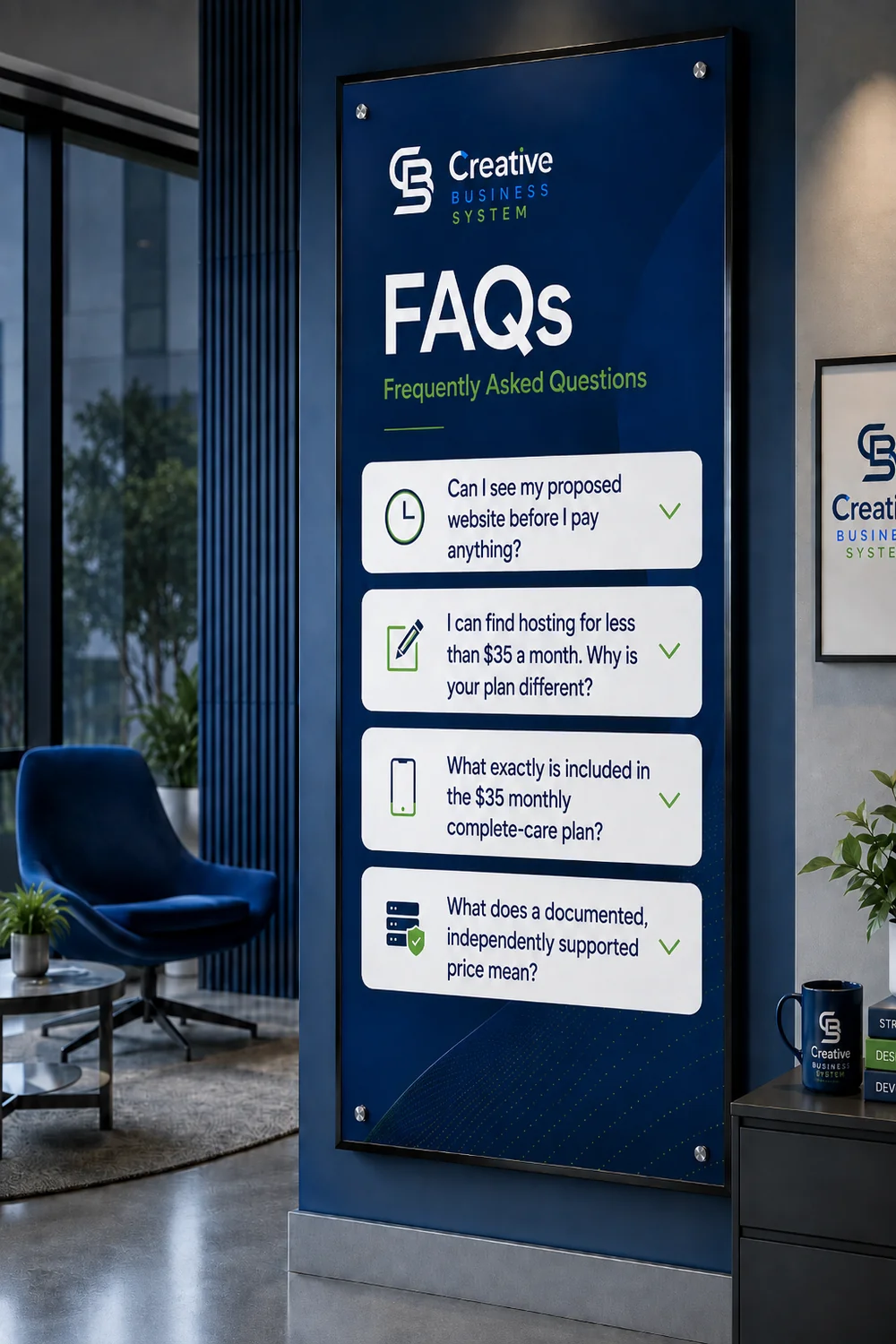
01 Can I see my proposed website before I pay anything?
Yes. Creative Business Systems prepares a custom presentation so you can review the proposed website direction before making any financial commitment. The presentation is created specifically for your business and may show the recommended page structure, visual direction, key messaging, important content sections, and how your services would be presented to prospective customers.
This changes the usual order of the website-buying process. Instead of paying first and hoping the finished work matches your expectations, you can examine what we are proposing, ask questions, and decide whether you want to move forward. You are not required to purchase the website merely because the custom presentation was prepared.
02 I can find hosting for less than $35 a month. Why is your plan different?
The $35 monthly charge is not for server space alone. It is a complete website-care plan that combines professional business-level dedicated hosting with WordPress maintenance, software updates, daily backups, advanced in-house security installed to your account, malware protection, uptime monitoring, technical support, routine content updates, and ongoing assistance.
A lower advertised hosting price usually covers only basic server space. Once a business adds the services needed to keep a WordPress website updated, protected, backed up, monitored, supported, and recoverable, the actual cost commonly rises through add-on fees or separate providers. Our plan states the essential services upfront so you can compare the complete cost of website ownership rather than comparing one low hosting price to an all-inclusive care package.
03 What exactly is included in the $35 monthly complete-care plan?
The plan is designed to give the website a dependable long-term home without requiring you to coordinate separate hosting, maintenance, security, backup, and support companies. It includes professional dedicated hosting, routine WordPress and software updates, daily backups, proactive security monitoring, malware protection, uptime monitoring, technical support, troubleshooting, routine content updates, and assistance when website issues arise.
No provider can guarantee that a website will never experience a technical problem or malicious attack. The purpose of complete care is to reduce risk, improve prevention and early detection, maintain reliable backups, and provide a clear recovery and support path. Major redesigns, new pages, or substantial new functionality may be separate project work, as documented in the applicable agreement.
04 What does a documented, independently supported price mean?
A site-specific market assessment explains how the completed website's fair value was established. Instead of relying on a generic price list, the assessment reviews the website that was actually prepared for your business. Relevant factors may include the project scope, page count, custom design, content development, functionality, technical quality, responsive construction, performance, included services, and comparable market pricing.
The report is generated through an artificial-intelligence evaluation process rather than being written by Creative Business Systems. Artificial intelligence acts as an independent third-party evaluator by applying documented criteria without having a financial interest in making the value higher or lower. This gives both sides a neutral reference point and allows you to review the factors, reasoning, and conclusion behind the proposed price instead of being asked to accept an unsupported number.
05 Is my website truly custom-built from the ground up?
Yes. Your website is planned around your business, services, customers, goals, content, and preferred visual direction. We do not begin by forcing your business into a generic template, page kit, or prebuilt demonstration site. The page hierarchy, section order, messaging, visual presentation, calls to action, and responsive behavior are developed specifically for your project.
Some customers arrive with a very specific vision. They may have seen another website they admire and ask us to create something with a similar appearance, layout, or user experience while fully customizing it for their own business. Others prefer a completely original design created from the ground up. Either approach is based on your preferences and business objectives.
Many customers simply view us as the professionals and prefer to leave the creative direction entirely in our hands. They provide information about their business, services, and goals, then trust us to develop a professional layout, visual style, messaging, and overall user experience that best represents their company. That is always an option, and many clients find it to be the easiest and most effective approach.
Reliable technical standards and reusable development practices may be used behind the scenes for security, stability, and performance, but the customer-facing website is not simply a recycled layout with a different logo and photographs. Whether the design is entirely original, intentionally modeled after a website you admire, or professionally developed using our own creative direction, the goal is to create a website that looks, functions, and represents your business the way you want it to. Exceptionally extensive or highly specialized custom design work may involve additional design fees, but this would always be discussed and approved before any additional work begins.
06 Will I own the completed website, and can I move it elsewhere?
Once the website has been completed and all project invoices have been paid in full, you own the completed website and the customer-specific content created for it. This generally includes your business information, written content, photographs you own, project-specific graphics, and the completed website files. Your website is transferable and is not locked to Creative Business Systems hosting.
If you choose to move, the website files and database can be packaged for transfer. You or your new provider are responsible for deploying and configuring the website on the new server. Third-party licenses, premium software, proprietary development systems, reusable programming frameworks, and pre-existing tools remain subject to their own licenses or ownership terms.

Additional questions about building and managing your website.
These next six answers cover redesigns, content, scheduling, responsive behavior, revisions, launch, and ongoing use.
07 Can you redesign or rebuild my existing website?
Yes. An existing website can be evaluated for outdated design, weak mobile behavior, confusing navigation, unclear service presentation, technical problems, difficult maintenance, or other limitations that keep it from representing the business effectively.
A redesign may preserve useful content, photographs, branding, domain authority, or selected functionality while replacing the page structure and presentation. Before work begins, the current site, hosting environment, software, content, and available access should be reviewed so the appropriate rebuild or migration approach can be determined.
08 Do you help organize or write the website content?
Yes. Content organization is part of creating a clear website. Existing information can be reviewed and arranged into a more useful page hierarchy with stronger section order, headings, calls to action, and customer-focused messaging.
The exact level of writing assistance depends on the project agreement. Some clients provide finished copy that needs editing and organization. Others need substantial rewriting or original content development. Extensive copywriting requirements should be identified during planning so they can be included in the scope and schedule.
09 How long does a typical website project take?
The schedule depends on the number of pages, the amount of original content, the complexity of the design, required functionality, and how quickly information and approvals are provided. A focused small-business website may take several weeks, while a larger custom project can require considerably more time.
Your proposal will establish an estimated schedule based on the agreed scope. Timely content delivery, organized feedback, and prompt approvals are important because delays in those areas normally affect the final launch date.
10 Will my website work correctly on phones and tablets?
Responsive behavior is a fundamental part of the build. Pages are structured and tested so text, images, buttons, forms, and content sections adapt to desktop, tablet, and mobile screen sizes without requiring visitors to zoom or scroll sideways.
Mobile design is not treated as a smaller copy of the desktop page. Content order, spacing, type size, buttons, image behavior, and navigation must remain practical on narrow screens. Complex third-party tools may have their own limitations, and those limitations will be identified whenever they affect the proposed experience.
11 How are revisions, feedback, and approvals handled?
Revisions work best when feedback is organized, specific, and connected to the project goals. Review stages are normally established for content structure, visual direction, page design, development, and final testing.
The proposal or agreement should identify the included revision process and what may be considered a scope change. Consolidated feedback helps prevent conflicting instructions and unnecessary delays. Once a stage is approved, significant changes to that approved work may require additional time or cost because later stages may already depend on it.
12 What happens after the new website launches?
Before launch, the site is reviewed for page completeness, responsive behavior, links, forms, basic browser compatibility, contact information, and other items included in the project testing process. Launch may also involve domain settings, hosting configuration, redirects, analytics, backups, and search-engine visibility settings.
After launch, the website moves into the complete-care plan for hosting, maintenance, backups, security monitoring, technical support, and routine assistance. Any warranty period, post-launch corrections, training, future expansion, or additional development will follow the terms established for the project. Launch completes the initial build, but it begins the website's ongoing working life.
Compare the complete offer, not one isolated number.
The presentation, care plan, and value assessment are designed to give you a clearer basis for making a confident decision.
Review the proposed websiteLook at the recommended direction, structure, messaging, presentation, and customer experience before making a financial commitment. |
Compare the complete planCompare hosting, maintenance, security, backups, monitoring, support, and routine assistance together rather than comparing hosting prices alone. |
Review the documented valueRead the site-specific artificial-intelligence assessment so you can see which factors were used to support the completed website's fair value. |
|
Ready to See What We Can Do?
Review a custom website presentation before making any financial commitment. |
Request Your Free Presentation |